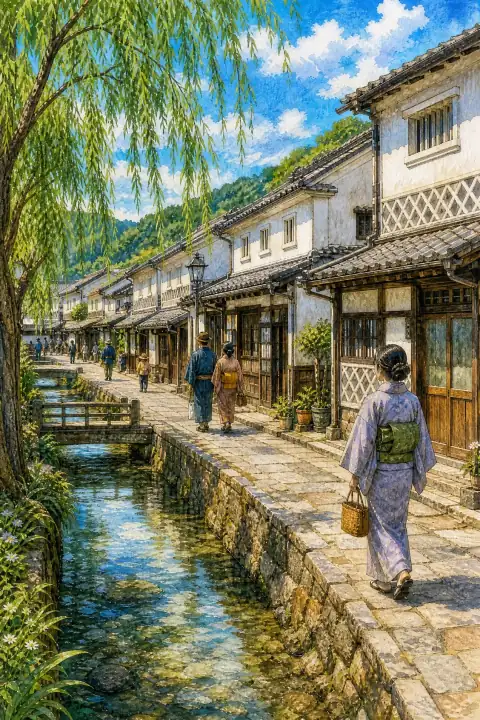
Kurayoshi White-Walled Storehouses
Also written: 倉吉白壁土蔵群 · 仓吉白壁土藏群 · 倉吉白壁土藏群
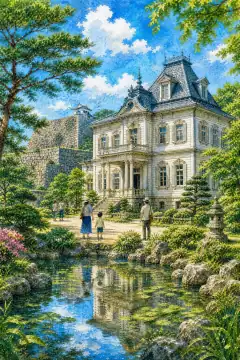
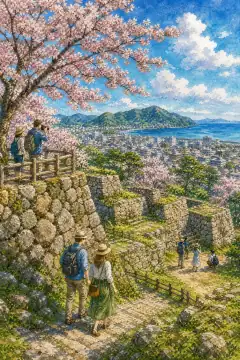
This district preserves a retro streetscape from the Edo and Meiji periods and is popular for strolling through traditional Japanese scenery.
An Illustrated Japan

Mizuky Workshop / An Illustrated Japan / Tottori / Townscape & Scenery / Kurayoshi White-Walled Storehouses
Also written: 倉吉白壁土蔵群 · 仓吉白壁土藏群 · 倉吉白壁土藏群
This district preserves a retro streetscape from the Edo and Meiji periods and is popular for strolling through traditional Japanese scenery.
An Illustrated Japan
Encountering Kurayoshi White-Walled Storehouses in Tottori means reading a sequence of historical layers preserved in form, material and daily practice. This district preserves a retro streetscape from the Edo and Meiji periods and is popular for strolling through traditional Japanese scenery. Formed by watershed and road alignment, the area developed as Tottori merchants and farmers adapted flatlands and slopes to seasonal water and wind. Edo-period cadastral records and Meiji land readjustment left the present lot lines, while Showa-era road widening and Heisei streetscape ordinances protected key sightlines. Local associations since the 1980s have maintained stone paving, hedgelines and viewpoints, with volunteer cleaning and small-scale repair continuing annually. Kurayoshi White-Walled Storehouses preserves spatial logic: sightlines to surrounding mountains, permeable edges between residence and field, and materials that age gracefully in Tottori humidity—timber, plaster, local stone and tile. Field surveys in the 1990s catalogued roof forms and drainage, feeding into municipal guidelines that limit height and signage. The result is a townscape that feels coherent without being frozen, allowing contemporary life inside historic fabric. Visitors often note changing light. Morning brings soft diffusion from inland mist, midday clarifies textures of wall and roof, late afternoon stretches shadows along lanes. A half-day walk covering approaches, central viewpoint and peripheral paths reveals seasonal markers: plum and cherry in late March to April, fresh green and irrigation flow in June, harvest stacking and festival lanterns in autumn, snow-lidded roofs in January. Information boards installed after 2000 offer multilingual notes on walking etiquette, private property boundaries and local production. Access is typically by local rail or bus with services every 20 to 40 minutes in daytime, less frequent on weekends; many visitors combine it with neighboring shrines, markets or onsen within 30 minutes walk or one short bus ride. Recent improvements include EV charging at municipal lots since 2021, barrier-reduced paths on main routes, and multilingual signage expanded after 2015. Conservation follows a low-intervention model: limit new construction materials, reuse timber from dismantled houses, direct part of facility revenue to trail, forest and festival maintenance, and cap group size for workshops. Documentation offices keep measured drawings and oral histories, open to researchers by appointment and summarized in quarterly newsletters distributed since the 1990s. In sum, Kurayoshi White-Walled Storehouses condenses a longer negotiation between Tottori natural structure and human habitation. What remains visible today—form, material, timing of use—results from incremental decisions rather than a single design moment. Revisiting across seasons makes this legible, as light, crop, festival calendar and maintenance cycle shift the appearance and activity. For travelers willing to walk slowly, check posted hours, respect private thresholds, and allocate time beyond a photo stop, it offers a durable, non-performative encounter with how a Japanese locale continues to be kept, altered and inherited.