Hakodate Mountain Night View
Also written: 函館山の夜景 · 从函馆山眺望夜景 · 從函館山眺望夜景
A jewel-box-like beauty, one of the world's three greatest night views, a romantic panorama.
An Illustrated Japan

Mizuky Workshop / An Illustrated Japan / Hokkaido / Famous Views / Hakodate Mountain Night View
Also written: 函館山の夜景 · 从函馆山眺望夜景 · 從函館山眺望夜景
A jewel-box-like beauty, one of the world's three greatest night views, a romantic panorama.
An Illustrated Japan
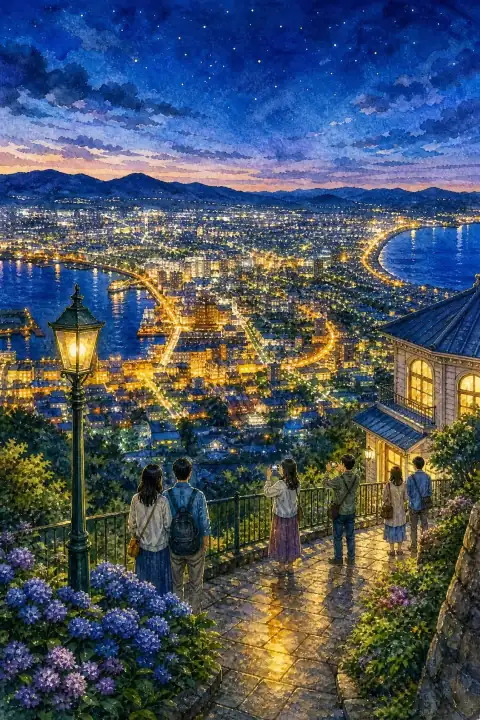
The night view from Mt. Hakodate in Hokkaido, at 334 m elevation and flanked on three sides by Hakodate Bay and the Tsugaru Strait, forms one of Japan's most celebrated nightscapes, often described as like an overturned jewel box spilling light, counted among the world's three great night views for its romantic panorama. The distinctive funnel-like topography pinches the city into an isthmus, so lights spread like a luminous hourglass. The history of light began when the Hakodate Electric Light Plant opened on January 15 1896, gradually adding streetlamps. After World War II the fortress designation was lifted, and in October 1946 administration transferred from the Ministry of Finance to Hakodate City. Tourism accelerated when the Mt. Hakodate Ropeway opened November 15 1958. Today the jewel-box quality first captures the eye, then deeper layers emerge. Guides explain landform - how elevation, bay curvature, and sea shape night visibility. Nearby shrines and temples maintain annual rites, letting visitors touch regional culture. Since 2019 calls to prevent microplastics and invasive species have been strengthened, with multilingual guidance. Public transport varies by season and some winter buses are suspended, so checking the official website is recommended. Fisheries and agriculture link with tourism; direct-sales stands bustle at harvest. Since around 2016 guided tours have become established, offering both learning and rest. Time on the mountain invites stepping away from daily routines to face nature and city light together. Crowding is common at sunset, so early arrival and patience improve experience, and weather can shift rapidly with winds and fog, adding drama but also requiring warm layers. Seasonal transformation adds variety: spring brings meltwater brightness and tender greens, summer deep foliage and long daylight, autumn clear air and colored leaves, winter snow silence that emphasizes shape and sound. Light changes hourly, so early morning and late afternoon are soft and photogenic while midday emphasizes clarity and blue tones. Visitors who linger discover small details - wind movement across water, distant bird calls, texture of volcanic rock and larch bark - that become the most lasting memories. Respectful behavior, staying on paths, carrying out waste, and supporting local shops helps preserve this landscape for future generations while making travel more meaningful.